Create your Study Path
Set topic confidence levels and find relevant guides.
Revision is not just rereading notes. Learn how to recall knowledge, practise applying it and use mistakes to improve before mocks and final examinations.
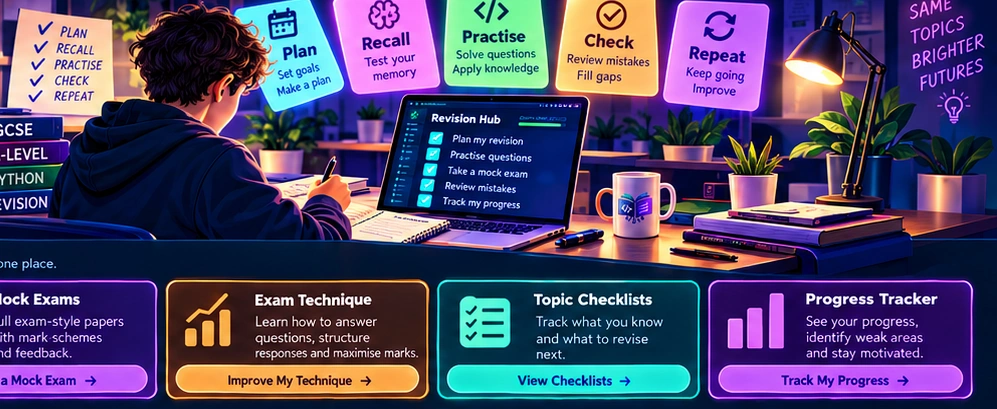
Choose a technique, make a plan, then test what you can recall.
Rereading can feel productive without proving you can recall the material. Try answering without notes, checking carefully, applying the knowledge and revisiting it later.
Choose the numbered topics for your OCR or AQA specification, then attempt an original 14-mark mini-mock and review any weaker areas.
Set topic confidence levels and find relevant guides.
Use realistic question styles and self-marking.
Effective revision involves returning to a topic, attempting to remember it without prompts, testing your understanding and correcting mistakes. Start here if you are unsure how to revise, or if your revision currently consists of reading or highlighting notes.
An explanation of active revision, common mistakes and a sample 25-minute study session.
Learn how to revise →Use brain dumps, flashcards and quick tests without looking at the answers.
Try active recall →Find out when to revisit topics and why switching question types can help.
Space your learning →Translate OCR and AQA exam notation into Python you already understand. Practise selection, loops, trace tables and original exam-style questions.
Read the illustrated guide →Start with your school’s current examination board and specification. These guides are independently written by TutorSyntax; they are not official endorsed revision guides.
Computer systems, data, networks, security and impacts of computing.
Revise Paper 1 →Algorithms, computational thinking, programming, logic and testing.
Revise Paper 2 →Algorithms and programming for the revised specification, with exams from 2027.
Revise Paper 1 →Data, systems, networks, cybersecurity, SQL and impacts.
Revise Paper 2 →Systems, algorithms, programming and the NEA.
A-level guide →Programming, computation, theory, data, networks and NEA.
A-level guide →Plan a realistic mock-revision week and practise answering under time pressure.
Mock guide →RAG-rate topics and track what you can remember and apply.
Open checklist →Understand command words, use mark allocations and learn to self-mark.
Exam techniques →Generate and print a realistic topic-based plan with a small weekly workload.
Make a plan →Short worked examples of key programming structures, plus prediction and debugging tasks.
Open Python reference →Apply your knowledge with TutorSyntax-written interactive and written questions.
Written questions →Choose your examination specification, practise a question and check your answer. Revisit weaker topics after a few days.
Independently written TutorSyntax content; not endorsed by OCR or AQA. Always check your school’s specification and mock coverage.
Explore 70 careers spanning AI, data, software, games, cloud, design, cybersecurity, robotics and research. Try a small career task and see possible UK study routes.