What does revision actually mean?
Revision means revisiting things you have already studied so that you can remember, explain and use them later. In Computer Science that could mean recalling the fetch–decode–execute cycle, converting binary accurately, tracing unfamiliar code or explaining a network-security choice.
Reading notes is a useful starting point when a topic is new or confusing. The limitation is that looking at the answer can make it seem obvious. To find out what you really know, close the notes and try to produce the answer yourself. This is called retrieval practice.
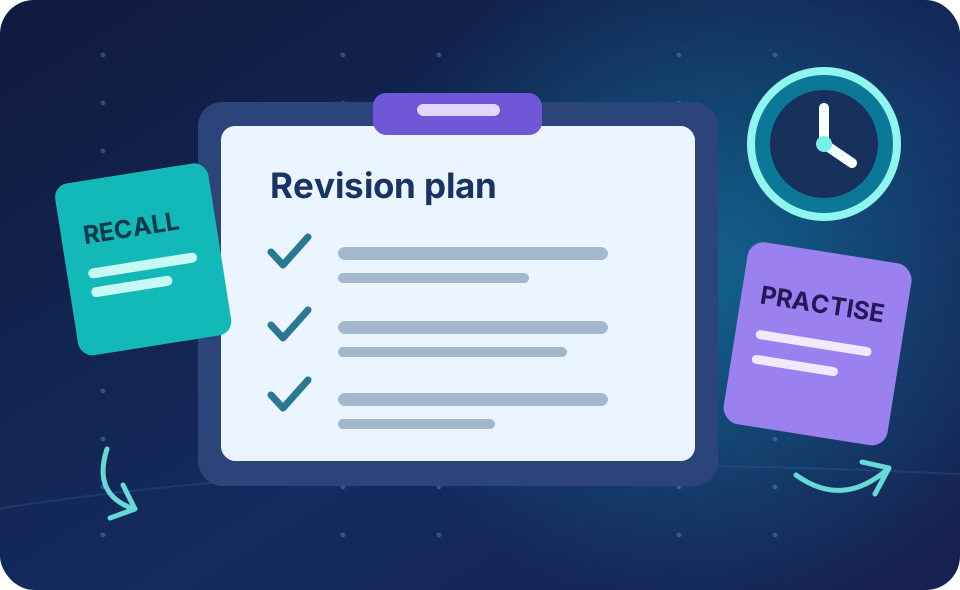
A 25-minute revision session that students can actually follow
| Time | Do this | Why |
|---|---|---|
| 0–3 min | Pick one narrow topic and one goal. | Know what you are trying to achieve. |
| 3–8 min | Brain dump without notes or answer five flashcards. | Discover what you remember. |
| 8–13 min | Check missing ideas in a guide; correct them in a different colour. | Fix misunderstandings. |
| 13–23 min | Answer two original exam-style questions or code a small task. | Apply knowledge independently. |
| 23–25 min | Record one mistake and schedule a short review. | Decide what to study next. |
For example, choose binary overflow. Write the greatest unsigned 8-bit value from memory, explain what happens when two numbers exceed it, then solve an addition question. Check each stage instead of only asking whether your final answer is correct.
Five revision strategies to try
- Retrieval practice: hide your notes; write or say the answer before checking.
- Spaced practice: revisit a topic over several shorter sessions.
- Exam question practice: use realistic questions and work through the marking points.
- Interleaving: mix suitable topics once you have learned the basics, for example binary, networks and algorithms.
- Explain it: teach a concept to someone else, or record a short explanation then check your accuracy.
No single method replaces understanding. Flashcards work well for facts and definitions, but programming and longer-response questions also demand application, testing and explanations.
What to do if you get questions wrong
A mistake during practice is information, not a verdict on your ability. Decide whether you forgot a fact, misunderstood the question, chose the wrong process, made a calculation error or ran out of time. Your next activity should address the cause.
Try without notes: You can recite what an algorithm is, but cannot trace a loop. What should your next revision task be?
Check an example answer and feedback
Practise tracing small loops with a variable table, then attempt a similar loop without help. More definition flashcards alone would not resolve the skill gap.
Useful next steps: learn retrieval practice, build a revision plan or try original quizzes.
Evidence and further reading
The Education Endowment Foundation emphasises teaching learners to plan, monitor and evaluate their own learning. The Learning Scientists summarise research-backed strategies such as retrieval and spacing. These links are for further reading, not an endorsement of TutorSyntax.